
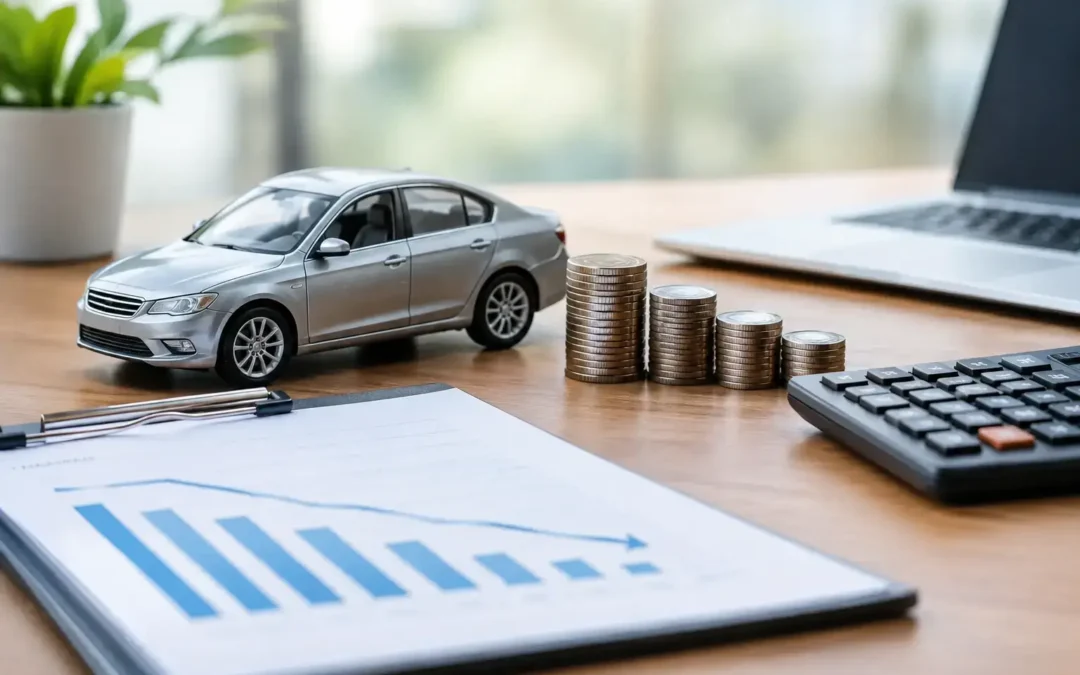
A car can look like a strong value at the showroom, then lose thousands in resale value before its first major service. Knowing how to calculate vehicle depreciation puts that cost in plain view, whether you are buying a used car in Cyprus, comparing premium models, or deciding whether a long-term rental offers better value for your lifestyle.
Depreciation is not a monthly bill you pay directly. It is the difference between what you pay for a vehicle and what you can sell it for later. Yet it can be one of the largest costs of ownership, especially with newer luxury vehicles, high-mileage cars, and models with limited local demand.
What Vehicle Depreciation Means in Real Terms
Vehicle depreciation is the loss in a car’s market value over time. It begins as soon as a new vehicle is registered and continues as it gains age, mileage, wear, and ownership history.
The basic calculation is straightforward:
Depreciation = Purchase price – Current market value
For example, if you buy a vehicle for $30,000 and its realistic resale value after three years is $20,000, it has depreciated by $10,000. That figure does not include fuel, insurance, maintenance, financing, registration, or repairs. It is simply the value that has disappeared from the vehicle itself.
To calculate the annual depreciation rate, use this formula:
Annual depreciation rate = (Purchase price – Current value) / Purchase price / Years owned x 100
Using the same example, $10,000 divided by $30,000 equals 33.3%. Over three years, that works out to an average annual depreciation rate of about 11.1%.
This is an average, not a guarantee. Cars rarely depreciate in a perfectly straight line. The largest drop often happens in the first one to three years, then the rate usually slows as the vehicle reaches a more affordable used-car price point.
How to Calculate Vehicle Depreciation Before You Buy
The most useful depreciation calculation is the one you make before committing to a car. It helps you estimate the true cost of owning a vehicle rather than focusing only on its purchase price or monthly finance payment.
Start with the actual purchase price. Use the negotiated price, including unavoidable dealer fees and registration costs if those are part of your outlay. Next, estimate the vehicle’s likely value at the point you expect to sell or trade it in.
For a three-year ownership period, look at comparable vehicles that are already three years older. Match the make, model, engine type, trim, mileage, and condition as closely as possible. A base-model hybrid city car and a high-spec premium SUV may have very different resale patterns, even if their original prices were similar.
Then apply the basic formula:
Expected depreciation over ownership period = Total purchase cost – Expected resale value
If a used Lexus is purchased for $38,000 and similar examples are expected to sell for around $29,000 in three years, estimated depreciation is $9,000. Divided by 36 months, that is approximately $250 per month before any running costs.
That monthly view is especially helpful when comparing ownership with a fixed-price long-term rental. A rental payment may appear higher at first glance, but it can include costs that ownership leaves you to manage separately, such as comprehensive insurance, maintenance, road tax, and tires.
Use Market Value, Not an Optimistic Asking Price
A common mistake is to calculate depreciation using the highest advertised price for similar cars. An asking price is not necessarily a selling price. A vehicle may remain listed for months because the seller is aiming too high, while the actual market value is lower.
Use several comparable listings and focus on realistic prices for vehicles in similar condition. If possible, allow for negotiation, trade-in value, and the time it may take to sell privately. In a smaller market such as Cyprus, local supply can have a meaningful effect. A desirable, well-maintained automatic hybrid may attract stronger demand than a model with expensive running costs or a specification that appeals to fewer buyers.
For a conservative estimate, use a resale value slightly below the middle of the comparable range. It is better to be pleasantly surprised by a stronger sale price than to build your budget around an optimistic one.
The Factors That Change a Car’s Depreciation
Age matters, but it is only one part of the calculation. Two cars of the same age can differ dramatically in value because the market is responding to much more than the year on the registration document.
Mileage is one of the biggest factors. Higher mileage generally means more mechanical wear and a smaller pool of buyers. A car driven 15,000 miles per year may hold value differently from the same model driven 6,000 miles per year, particularly in premium segments where buyers expect excellent condition.
Condition is equally important. Service records, tire condition, paintwork, interior wear, accident history, and warning lights all influence resale confidence. A car that has been cared for properly can command more than an identical model with incomplete history or visible neglect.
Brand and model reputation also matter. Models known for reliability, low fuel consumption, practical features, and readily available parts often hold value well. Some premium vehicles retain demand because of their badge, comfort, and performance, but they can still depreciate quickly if maintenance costs are high or newer versions introduce major upgrades.
Powertrain choice can shift the numbers too. In Cyprus, fuel efficiency and everyday usability can support demand for hybrids and economical automatic cars. Electric vehicles may offer low running costs, but depreciation can be harder to predict when battery technology, charging access, incentives, and new-model pricing are changing quickly.
Finally, timing matters. A convertible may be easier to sell in warmer months. Large SUVs may attract more interest when family travel demand is high. Changes in taxes, fuel prices, import availability, or new-car discounts can all affect used values.
Straight-Line Depreciation vs. Market Depreciation
You may see depreciation calculated with a straight-line method. This spreads the loss evenly across each year:
Annual straight-line depreciation = (Purchase price – Estimated residual value) / Years of ownership
For example, a $40,000 car expected to be worth $22,000 after four years would depreciate by $4,500 per year under this method.
Straight-line depreciation is useful for budgeting because it is simple and predictable. However, it is not the best way to forecast a resale price. Real vehicles typically lose value faster early on, then level out. Market depreciation is more accurate for a buying decision because it is based on what comparable vehicles are actually worth.
Use straight-line depreciation to organize a household or business budget. Use market comparisons to decide whether the car is likely to be a smart purchase.
Compare Depreciation With Your Total Monthly Cost
Depreciation should never be viewed alone. A car that holds its value well can still be costly if it has high insurance premiums, expensive repairs, poor fuel economy, or financing interest. On the other hand, a vehicle with faster depreciation may still suit you if it delivers the comfort, space, or executive image you need and you plan to keep it for many years.
For a clearer comparison, calculate:
Monthly ownership cost = Monthly depreciation + insurance + maintenance + tires + road tax + financing interest + fuel
Fuel will vary by how much you drive, so keep it separate if you are comparing vehicles with different usage patterns. The rest of the costs show why a fixed monthly rental can be attractive for drivers who value predictable expenses. You are not exposed to unexpected maintenance bills or to the uncertainty of resale value when it is time to move on.
This can be particularly valuable for professionals and companies that need dependable transport without tying up capital in a vehicle that may lose value faster than expected.
When Buying Still Makes Sense
Buying is not automatically the wrong choice. It can make excellent financial sense when you select a well-priced used vehicle, maintain it carefully, drive moderate mileage, and keep it long enough to spread the initial depreciation over more years.
A used car that has already taken its sharpest early depreciation can be a particularly strong option. The trade-off is that maintenance risk may rise with age, and you will still need a plan for eventual resale. Buying also suits drivers who want to personalize their car, expect to keep it for a long time, or have a clear understanding of the local used-car market.
The right decision depends on the vehicle, your expected mileage, your budget, and how much certainty you want from month to month. Before choosing, estimate the depreciation honestly, compare it with every other ownership cost, and give the resale value the same attention you give the purchase price. That is how a vehicle becomes not only a pleasure to drive, but a decision you can feel confident about.